The Iliad
While putting back something I had read a while ago, I saw the books by Theodor Kallifatides on my shelf. In Spain, they are all published by Galaxia Gutenberg, and they all have dark red orange spines. Following the random but not totally random order of my book, they sit all together. Kallifatides is one of my favorite writers, and I own a bunch of them. All there, all red, they are easy to spot. I got curious about which one was the first I read. I have a lot of time on my hands, as you see. It was The Siege of Troy. I got it from my mother. I’m sure that, as always, she complained that I didn’t read it. According to her, I never read the books she gives me. Sometimes she’s right, and sometimes they’re aging, accumulating a classy layer of dust before they are read. Anyways, I have no idea when I got or read it. But I still remember how much I enjoyed it.
The Siege of Troy takes place in a village in the Peloponnese—that’s where a lot of Kallifatides’ books seem to be set—during WWII. The Nazis have built a small airfield just outside of the village, and when it’s attacked by the Allies, everybody takes refuge in some caves. There, the village teacher, a young woman, reads the Iliad to her pupils. Extracts of the actual Iliad are built into the text. I loved the style of writing and the feel of the village, but what I remember most about this book is how naturally fit these passages of the Iliad in the story.
I have tried to read the actual Iliad a few times. In my own version, Agamemnon, Menelaus, Achilles, Paris, Patroclus, Hector, the gods, and even Helen forget their quarrels, team up, and defeat me. In way less than ten years. No need for a wooden horse.
In German, there is the fantastic word Dünnbrettbohrer. Like so many German words, a composite: Dünn means thin, Brett means board, and ein Bohrer is a drill. A drill for thin boards. Somebody without the stamina or character to take on harder tasks. Me. And reading the Iliad is a hard task. There are too many fights, too many gods, too much brutality. It is very linear. There are too many adjectives.
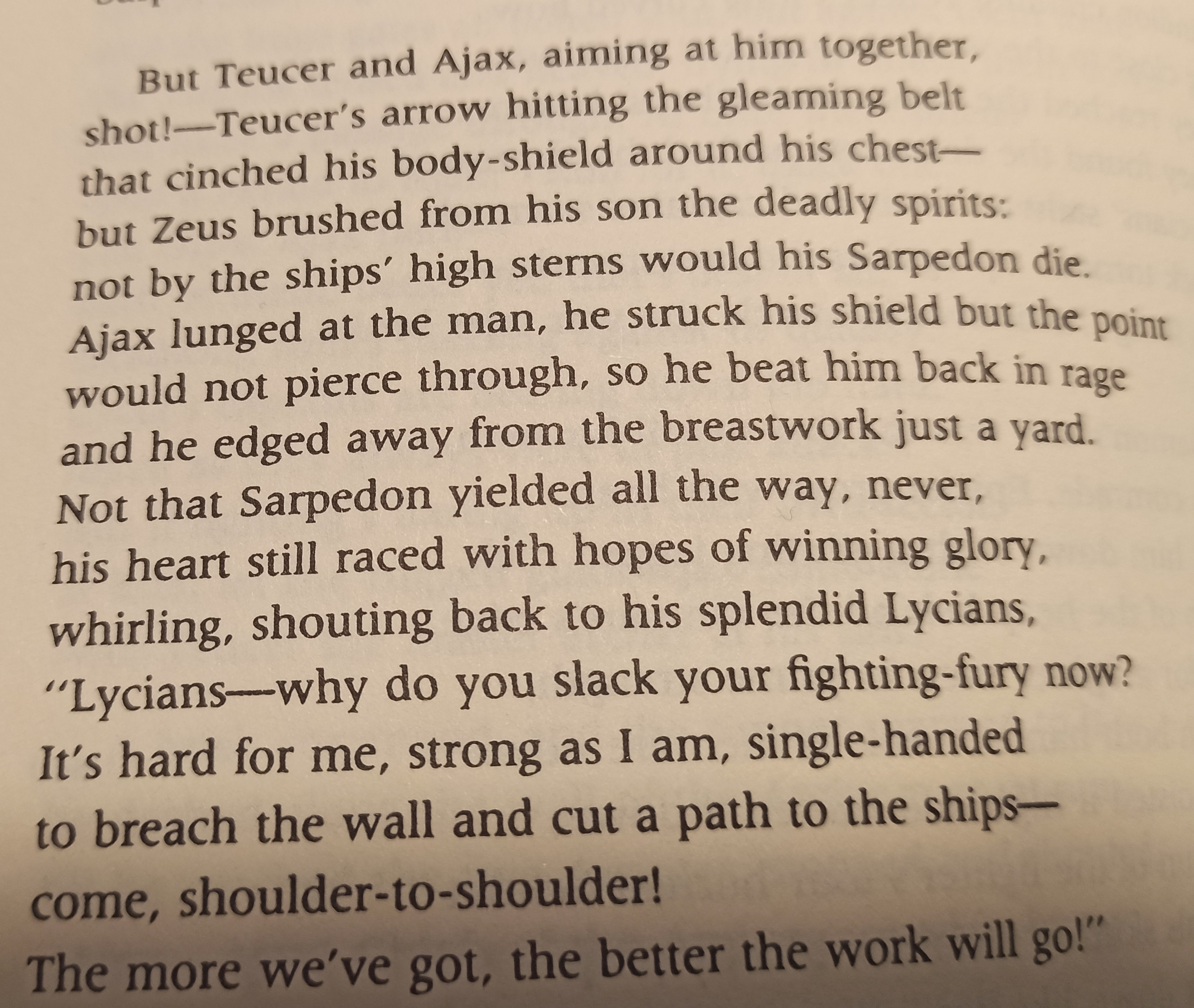
To illustrate this, I just asked Le Chat to give me a random passage—not one of the famous ones. Submissive and subservient as it is, it provided one. Helpfully, it came with a reference: Book X, lines 377-385 from the Robert Fagles translation, the one I have. Curious, I went to check. The best one can say is that what Le Chat gave me had something to do with what happens around there. But it was definitively made up. Totally. So, I just took a photo of a random page. What you see there is the kind of text that defeats a Dünnbrettbohrer like me.
The extracts of the Iliad in The Siege of Troy feel different. They serve as background to the story of that village during the war. Or maybe it’s the other way around. Moreover, they aren’t direct renderings of the original. Achilles still kills Herctor and such, but the text has been modernized, reflecting more of what one expects from fiction now. I remember that when I was reading it, it reminded me of Alessandro Baricco’s An Iliad—captain obvious talking to you, I know. Anyways, what Baricco does is shorten the original text and add to it things one doesn’t find there, like the inner thoughts of the characters. Baricco’s additions are printed with a different style and are directly recognizable. As he described it, when trying to restore a magnificent antique building, one can try to rebuild it faithfully to the original, but one can also use obviously new materials like glass or concrete, so that the new additions are anything but hidden. It’s the contrast that makes the original building shine. I’m paraphrasing, but that was the idea. And I found that it perfectly described what he did in An Iliad. If you haven’t read it, do yourself a favor and get it. It’s an impressive book.