April 9th
As I already told you in this previous post, whenever I spend any time anywhere, I tend to become a regular at some bar, café, or restaurant. It might be a nice place, like a pub, or it might be a Starbucks two blocks from where I am staying for the week. I like to think that I am following Anthony Bourdain’s advice, quoted on the right. A less self-flattering, and surely more realistic, conclusion is that I am a lousy tourist.
In contrast, my sister is highly dedicated. Being also a great leader of multitudes, she approaches the issue of being a tourist with true missionary zeal. Everybody is shepherded to admire the wonders of the world. Nothing is left unseen. The family loves it. From my point of view, it is horror, and I resort to every trick in the book to evaporate. It is just a question of survival.
When we all went to London earlier this year, I ended up hiding in some weird places like a Salvation Army café near Oxford Circus—a place without windows, with comfy chairs, where everyone was friendly and had a walker, but which, most importantly, was a haven of peace and calm in the middle of that anthill. I also went to a lot of bookstores. In one of them, Daunt Books, I picked up On the Calculation of Volume, by Solvej Balle. I had never heard of it, nor of the author. I guess that, being the nerd I am, I was attracted by the mathy-sounding title. It has nothing to do with math.
Now, as soon as I started reading, I was hooked. The basic idea is that the main character, Tara Selter, a young woman running an antique book business with her husband, gets trapped in a time loop. She is stuck on the 18th of November. A bit like in Groundhog Day, but I feel almost dirty making this comparison. While Groundhog Day is a nice movie, it is two hours of somewhat light, romantic, vaguely tacky comedy. On the other hand, On the Calculation of Volume is a truly amazing, magnificent book. In some sense, it is philosophical, but not heavy in that way. What it is, is deeply human. Often, one has the feeling that the book rolls toward you like a truck, that what it is describing is getting closer and closer to something deep within you—at the end of the day, one says metaphorically that one finds oneself “in Groundhog Day”—so close that it becomes vaguely uncomfortable. It is an unsettling book. And then, when it seems that you will be run over, the book takes a turn and goes along more peaceful and neutral paths, leading somewhere surprising and unexpected. And then it does it again, touching a different chord within you. One has the feeling that the author is both incredibly serious and playing with the reader. Lacking adjectives, let me repeat myself: a magnificent, unsettling book. At the same time, it is fast and easy to read.
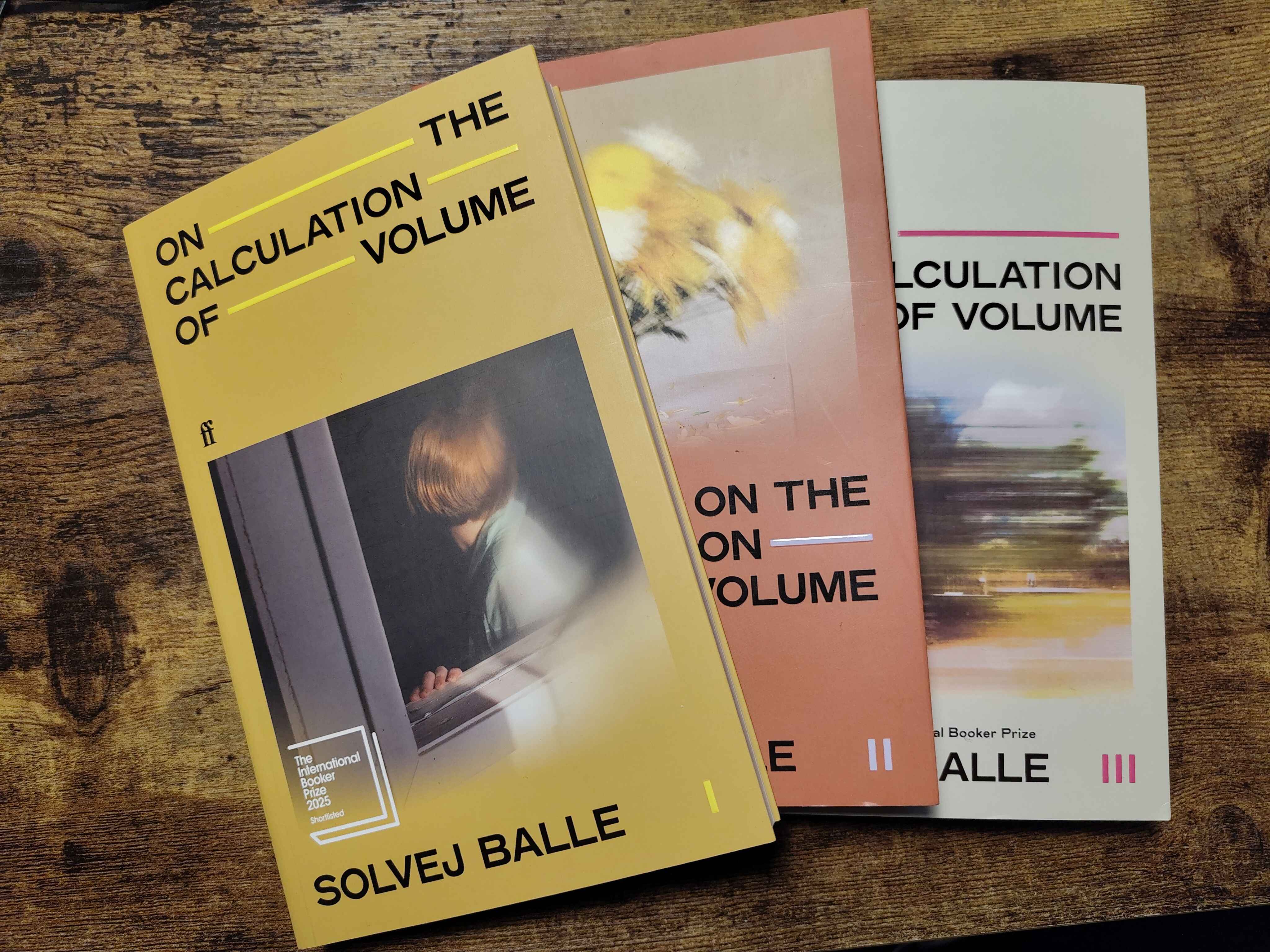
Now, when I bought On the Calculation of Volume, I interpreted the small yellow vertical line on the lower right corner of the cover as an element of design, to match in color with the horizontal lines between the words in the title. At some point, it dawned on me that this was a Roman numeral, indicating that it was just the first volume. I read the second volume straight away. And then I had to wait. In Danish, all six volumes have been published, but who the fuck speaks Danish? The third volume was published in English on November 18th, and a week later it was waiting for me in the bookstore. I just finished it. Still an amazing book. The fourth volume is expected in English on April 9th, and this explains the title of this post. The date is marked on my calendar.