Reversing the Counter
I read yesterday Graeme Wood’s article “Something Is Happening to America’s Moral Code” in The Atlantic. I didn’t like it very much, but it has kept me thinking. It discusses a New York Times podcast about what they call “microlooting”—the idea that stealing small things from large corporations might be a form of resistance against the all-powerful, against those who profit from an inherently unfair system. The Atlantic article ridicules the people in that podcast as basically three posh individuals, dressed in Ralph Lauren, discussing the revolutionary, moral value of stealing organic avocados—at least if you can get away with it. And, well, if one watches the NYT podcast, it is hard not to agree.
At the same time, there is something that really irks me in Wood’s article. I guess that, first, there is the title. The sentence “Something is happening to America’s moral code” seems to suggest that this is a new phenomenon. Well, although they were exceptions, I can definitely think of a couple of guys I knew in the US who, without needing to, would have stolen avocados if they knew it would have no consequences. They might even have made a pseudo-political argument for it. So, I am not sure that it is something new. Although it could maybe be true that it is more prevalent. I don’t know. I haven’t been there in 10 years. But it seems to me that the world is now full of takes on moral decay, and this article smelled like that. There has always been rot, there will always be, but most people’s morals are not decaying.
Now, that was a minor, petty point from my side, but that title really bugs me. I guess that, in part, it is because there clearly is an “American moral code,” and it is a code with which I both agree and disagree. I guess you could describe my status as cognitive dissonance.
Evidently, there are incredibly many things in the US that are not “moral.” The death penalty is not moral—and Trump just reintroduced the firing squad. The fact that, in a rich society, hospital bills drive people into insolvency is not moral. The extent of unrestrained consumption is not moral. Inequality is not moral. But this is not what all of this is about. If it were, I would be speaking about hypocrisy, not cognitive dissonance.
When I was in the US, I was amazed by how law-abiding people were. Sure, there is a lot of crime, and the threat of violence is much more present than anywhere else I have been. But, like everywhere, the vast majority of people do not engage in anything like that. There is reckless driving, drunk driving, but most people keep to the speed limit even if they are alone on a 40-mile-long straight highway in Kansas. In the residential area of a city, drivers stop at every crossing, even if it is 3 a.m. and there is no chance anybody is around. Not slow down, but actually stop. And not only does the vast majority of people follow rules, but they also believe in them. What I found most amazing was the extent to which people in universities considered cheating on an exam to be almost a capital offense. I was amazed by the fact that there were “take-home exams,” and that some institutions had an “honor code” by which students agreed not to cheat. In these places, the faculty was not allowed to invigilate the exams because that would be showing that they didn’t trust the students to abide by the honor code. There was a case of a girl who, at some point, came to my office to return her homework early because she didn’t want her friends to cheat by copying from her. I didn’t have the impression that she would be unhappy if her friends did well, but rather that she didn’t want to have anything to do with something as morally wrong as cheating. If you are Spanish, at least if you are Spanish and grew up when I did, this is all science fiction. There really is an “American moral code.”
If I think about it in the abstract, then I think that a society ruled by such a code is better. I try to educate my children to be good members of society, and, together with many other things, that means following rules and being good citizens. At the same time, the “American moral code” irks me. I guess that part of it is political. Graeme Wood starts his Atlantic article as follows:
The late political scientist James C. Scott endorsed what he called “anarchist calisthenics”—the regular practice of small acts of lawbreaking and disobedience. Jaywalk at an empty intersection. Have a beer in the park. Smuggle a pudding cup past the TSA agents. The point, Scott said, was to keep the civic muscles strong. Without constant reinforcement, these muscles will atrophy, and when real tyranny arrives, the flabby citizen will be powerless to resist. Scott particularly enjoyed telling Germans to get their reps in, because their grandparents had not.
Well, that is a bit ridiculous, and the reference to the Germans is absolutely stupid, but there is a point. In On Civil Disobedience, Thoreau describes the government as an “expedient,” a tool that citizens create because it has advantages, but a tool that produces friction. In some sense, one could say the same about society at large, and to a very large extent, society is nothing more than a moral code. Now, I totally think that “government” is a useful tool and that human happiness is impossible outside of a well-working society, but it seems also important to me to keep in mind that these are means to a goal, that their specific characteristics have no sacred value, that the limits they impose are social conventions, and that, at the end of the day, it is the moral obligation of individuals to decide what they do or do not do. Thoreau went to jail because he refused to pay state taxes because the state of Massachusetts (if I remember correctly) was not opposing the Mexican-American War of 1848. He refused even when the prosecutor offered to pay Thoreau’s taxes himself. Most of us, starting with myself, are no Thoreau, but I think that it is important to know that one can avoid collaborating if one disagrees with what the state and society are doing. I guess that I have always been a bit of an anarchist.
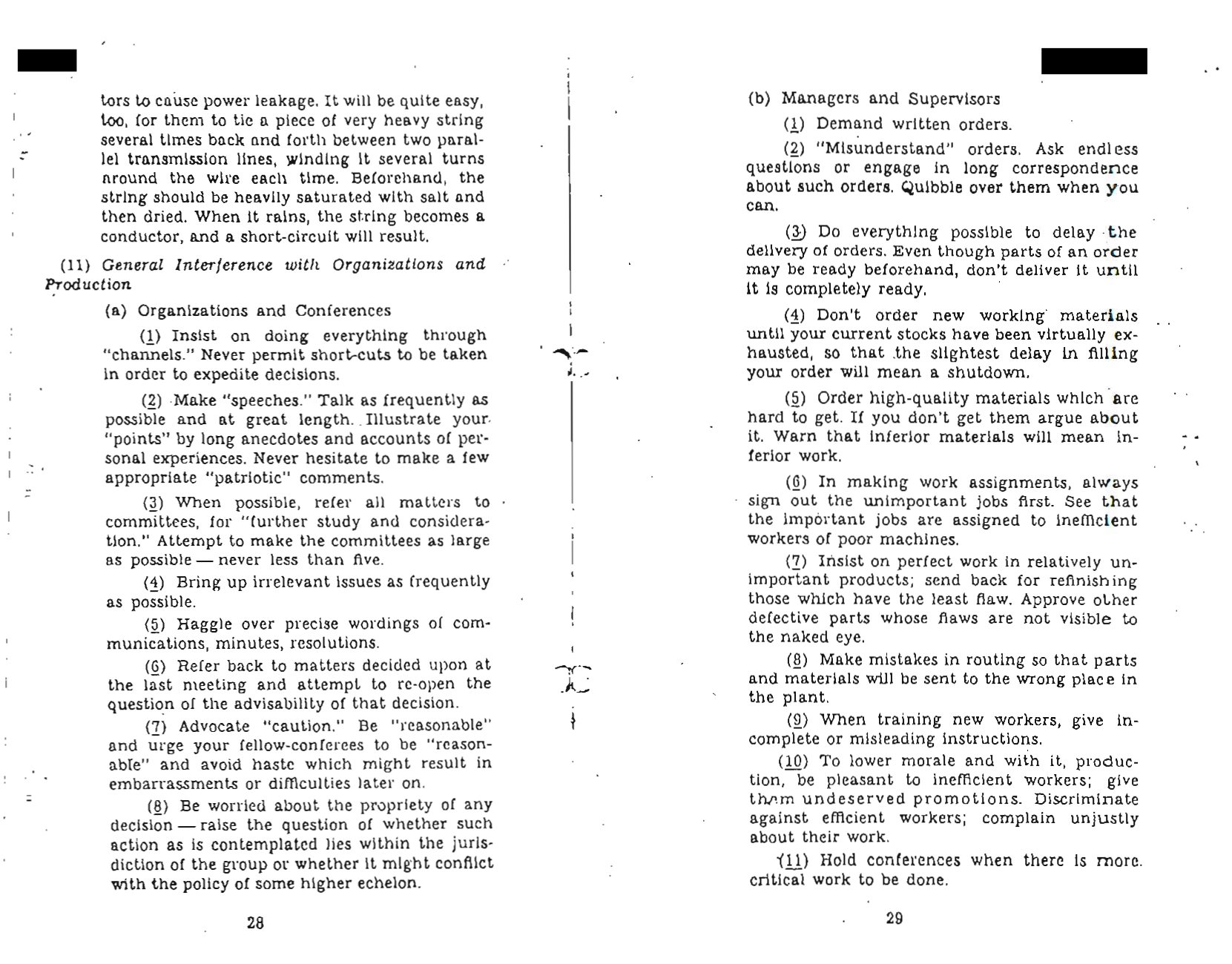
Incidentally, by “not collaborating,” one pays a price, but one should not hide behind that because there are many levels. And it is not me who is saying it, but the OSS—the predecessor of the CIA: here you have a link to the Simple Sabotage Manual, a booklet listing what individual citizens in occupied Europe could do to hinder the German war effort. Here is an extract of the things they recommended:
Anyways, that was a distraction. Going back to the “American Moral Code,” I guess that what irked me was its absolutism. Its Calvinist nature.
Something else that bothered me was that there is something enormously Americentric in it. I mean, somewhere in its absolutism, in the moral horror about the idea of students cheating, lies the idea of superiority toward other societies where there is much more leniency toward such behavior. There is somehow the unspoken idea that if other people knew or could, they would also abide by the American moral code, that they would live like Americans do.
Other moral codes definitely exist. In Spain, at least when I was growing up, the idea was that, on the one hand, it was okay to cheat the state or the powerful, but that, on the other hand, it would be definitely wrong to cheat people one knew or people with whom one had some form of relationship. In fact, the taboo against cheating was inversely proportional to how close one was to the cheated. Let me give some examples:
- Although most people paid taxes, finding creative ways not to, or simply not doing so, was actually kind of celebrated. At the same time, I believe that sometimes people avoided them simply because it felt unfair.
For example, at some point, my uncle got some money from his parents to finally be able to buy his house and move on his own. He got that money, I guess, as some form of inheritance while everybody was alive. To balance things and to avoid eventual issues on rules about how the inheritance should be divided, my father got to buy his parents’ house for an absolutely ridiculous amount of money. In the process, the state was cheated out of quite a few taxes. Now, I am sure that nobody framed it in any ideological terms, but I am sure that it was clear to everybody:
- that it was morally right for my grandparents (a retired merchant sailor and a housewife) to help my uncle (an electrician working shifts in a steel-making factory) get a place of his own (my cousins were maybe 10 or so at the time),
- that fairness meant that my father had to get also a comparable form of benefit, and
- that it was wrong that the state wanted to interfere, maybe making it unviable. So, when it came to it, the family trumped the state in the morality scale, and, once it was clear that one had gotten away with it, I don’t think that anybody lost a night’s sleep about that. In fact, I am pretty sure that the feeling was that the right thing had been done.
-
When I was growing up, if one broke anything belonging to a neighbor, as little as it might be, one was led to the neighbor’s house to explain what happened and apologize. Naturally, it would have been absolutely unacceptable to steal anything from neighbors or even from small merchants. On the other hand, making the electricity meter run backward for half of the month was just a problem of knowing how to do it (my uncle was an electrician, as I mentioned) and of logistics (I guess that one had to make sure that the consumption was positive), not of morals. One would have never cheated if it meant that the neighbor’s bill went up. Along the same lines, when the city was building a promenade, quite a few of those big concrete tiles were first socialized and then privatized with plans of building a footpath or something like that. There is no way one would have done that if it had been a local builder constructing that promenade.
- Cheating in middle and high school was not quite a universal sport because one could decide whether one was copying somebody else’s homework or cheating in exams. I did. A lot. All those things. On the other hand, what nobody would have considered doing was not helping others cheat in a test or with their homework. One could decide how much risk one took, although the risk was pretty much nonexistent, but if somebody had done anything to prevent others from cheating—like that girl I mentioned earlier, returning her homework early—then one would have immediately become a social outcast. Nobody even considered that possibility. Nobody framed it as us pupils fighting the oppression of the school system, but there were clearly two classes (pupils and teachers), and one knew which one was theirs and who was the all-powerful opponent—I smirk when I write “all-powerful” in reference to my school teachers, but that is another matter.
Now, I see the advantages of paying taxes, I see that those concrete tiles were being paid for by the city and hence ultimately by everyone and their neighbors, and I see the futility of cheating in school. I prefer to live in a society where these things are less prevalent. I definitely prefer to live in a society that distributes jobs and honors according to meritocratic principles instead of based on connections. But there was clearly a moral code, one that just prioritized different things than the “American moral code.” Sure, Spanish society was kind of dysfunctional, and I am happy that now it seems that nobody proudly announces having cheated on taxes. But Spanish society—that is, the moral code it follows—had (and has) some strengths that other societies don’t have, and vice versa. I mean, the slightly tribal, almost mafiosi, principles that “my friends are my friends” and “family is family” also clearly create cohesion. A society where you know that people near you, when asked to jump because you need them to jump, will feel that the natural thing is to ask “how high?” has cohesion. They might or might not jump, but if they don’t, they will still need to justify it to themselves. When “the cauliflower grower’s” brother needed help, the question was how to get it, not whether to get it. When my father was sick, a friend of my parents, somebody who is not rich, offered on his own account a pretty decent amount of money if it was needed for the treatment. Let me tell you that creates cohesion. At my scale, I love math, I want jobs to be distributed fairly (and I largely believe that they are), but if there is somebody I like, I will do as much as I can to support them. I will not go politically mafiosi—in any case, I live on the moon for all those things—but I will give them my time, and if I have an idea, I will share it, and I will be happy for them to get as much credit as they can. I see that this is neither impressive nor heroic, but what do you expect from a centrist dad who works as a civil servant?
The people in that New York Times podcast were absolutely ridiculous, but the slightly absolutist position in the article from The Atlantic really irked me. You know, when I lived in the US, there were many things about US society I liked, about the “American Moral Code,” but let me make clear that if my uncle still exchanged the poles of the electricity meter to make it count down, and if somebody were to morally criticize him, then I would know on which side to stand. Not only is my uncle my uncle, but the little anarchist flame in me tells me that it must be okay to minimally cheat on the utility company.