Cats
Everybody who knows me knows that I love cats. The first time I actually spent some time with a cat was when, coming back from Europe, I found one in my apartment in Chicago. A friend had left town for a month or so, and the bastard—The Bastard—needed a place to stay. Evidently, somebody had been coming to take care of him before I returned, but then it was just The Bastard and me for a few weeks. It was one of those really hot and sticky Midwestern summers, and that hairball spent his days lying in the bathtub, shedding hair. Lots of hair.
Cats are amazingly different from each other. At the time, The Bastard was a scientist. He was the cat version of Newton, fascinated by the laws of gravity. I don’t know how many glasses—preferably half full—he pawed off a table, but I do know how lucky I was to have a dollar store down the block. Otherwise, I would have had to start adopting The Bastard’s habit of drinking by licking from a dripping faucet.
Eventually, my friend came back and took The Bastard with her. In other words, he moved back in with his roommate—though the French colocataire does sound nicer. I’ve wondered if it was during that month that I caught the bug that’s supposed to make us love cats. In reality, I have no clue if I have toxoplasmosis or not, but I wouldn’t be surprised in the slightest. What I do know is that I have the cat bug. I share a home with two humans and five cats. They are crazy in their own ways and take their craziness very seriously—cats included. When I go somewhere, I take pictures of cats. Basically, no landscapes, few people, lots of cats. I talk to cats. It’s true that I mostly call them things like “hijo de puta”, but remember that Spanish is a language in which one demonstrates love and appreciation through insult and abuse. That magnificent sentence was an approximation of a quote from Homer’s Odyssey, one of the many books I have with cats in them. I actually didn’t like Homer’s Odyssey very much. If you want to read a book with cats in them, go for On Cats, The Travelling Cat Chronicles or Lost Cat. You’ll like these books even if you’re not a cat person.
People who don’t live with cats don’t get them. It’s true that cats don’t do drama. It’s true that often you don’t see directly how a cat is feeling. Yes, there’s the tail and such, but that basically amounts to reducing human communication to observing how people walk. It says something, but not that much. People have tried to figure out what their cats are trying to say when they meow. Evidently, there are scientist who study such things, but honestly, that sounds a bit like bollocks to me. Probably less bollocks than the research I do myself, but bollocks anyway.
Understanding a cat you’ve just met seems impossible to me. Cats know their worth, and unless they evidently want something from you, they make it clear that you’re not worth their time. Most of the time, if you’re at least five meters away, they ignore you. Then, sometimes, you’re walking around and you meet a cat who allows you to pet them, but usually, a cat you’ve just met is only going to tell you, “Leave me alone.” Even the friendliest cats might let you pet them for a bit, but then they think, “That’s enough.” They’ll move a few meters away and start licking their paws, their whole body language saying that the audience is over. As long as you’re at a safe distance, you don’t exist. You are nothing to them. And if you’ve overstayed your welcome while petting them, you must prepare for the possibility of the cat clearly communicating that to you—with their nails, not their tail.
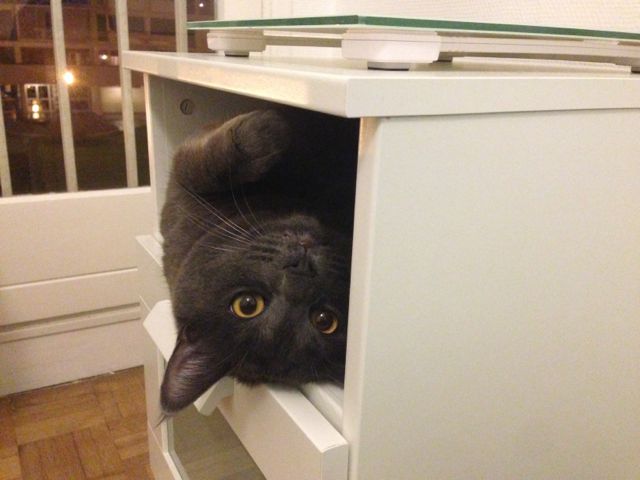
On the other hand, when you live with a cat, you “understand” that cat. You read their face. You see their eyes change. You recognize when they’re willing to have their belly rubbed and when they’re not in the mood. You see if they’re worried or bored. If a cat is depressed, you see it. And if there are several cats, it’s amazing to see how different their personalities can be. If you don’t have cats, you might be thinking that words like “depressed” or “personality” are out of place here. Maybe you even have a bit of a condescending smile, thinking that all this anthropomorphizing is just crazy cat lady talk. Let me correct you: it would be crazy cat Spaniard talk. And you’d be wrong. What is true is that the words you’d use to describe human personalities don’t serve very well to describe cats. Nobody would describe a cat as “optimistic,” “creative,” “kind,” “rude,” “vain,” or “wise.”
When you live with cats, you also know what they think of you. Of your personality, I guess. As with humans, what they think of you often changes a few times a day—not just when you have treats or flick the ring of a tuna can. Sometimes they want to be petted and lie next to you. Sometimes they think you’re a pain and make wide circles around you. Sometimes, they come to headbutt you. But you see it when your cat loves you and counts on you. That feeling makes you a better human.
Sanchito was the most problematic cat I’ve known. He was a gray Chartreux-looking cat, but he was born in a garage to a pitch-black cat. He was the capo mafiosi of the neighborhood and got into constant fights with other cats. He also got into lots of trouble. All the time. In 2018, he had a bad accident—probably another cat hit him. He broke his jawbone and had to be operated on. For two months, I had to feed him through a tube three times a day. It wasn’t easy, and there were all sorts of complications. That’s an understatement, but it was worse for the poor cat. For two months, he couldn’t do any of the things he liked. He had to wear a cone all the time around his neck. There was a tube coming of his throat. If you thought earlier that the word “depressed” was exaggerated when applied to a cat, let me tell you: you have no idea what you’re talking about. Once this ordeal was over, Sanchito went back to being himself—the terror of the neighborhood. But his health was never the same, and every six months we had some more or less urgent vet visit. Sanchito hated these visits, like all cats do. But it was clear that he counted on me. And he loved me. Maybe other people wouldn’t see it, but I could feel it. Sanchito died almost a year ago. Cancer. I remember every cat I’ve lived with, but Sanchito is the cat I will never forget. I get teary when I think he’s not here anymore.