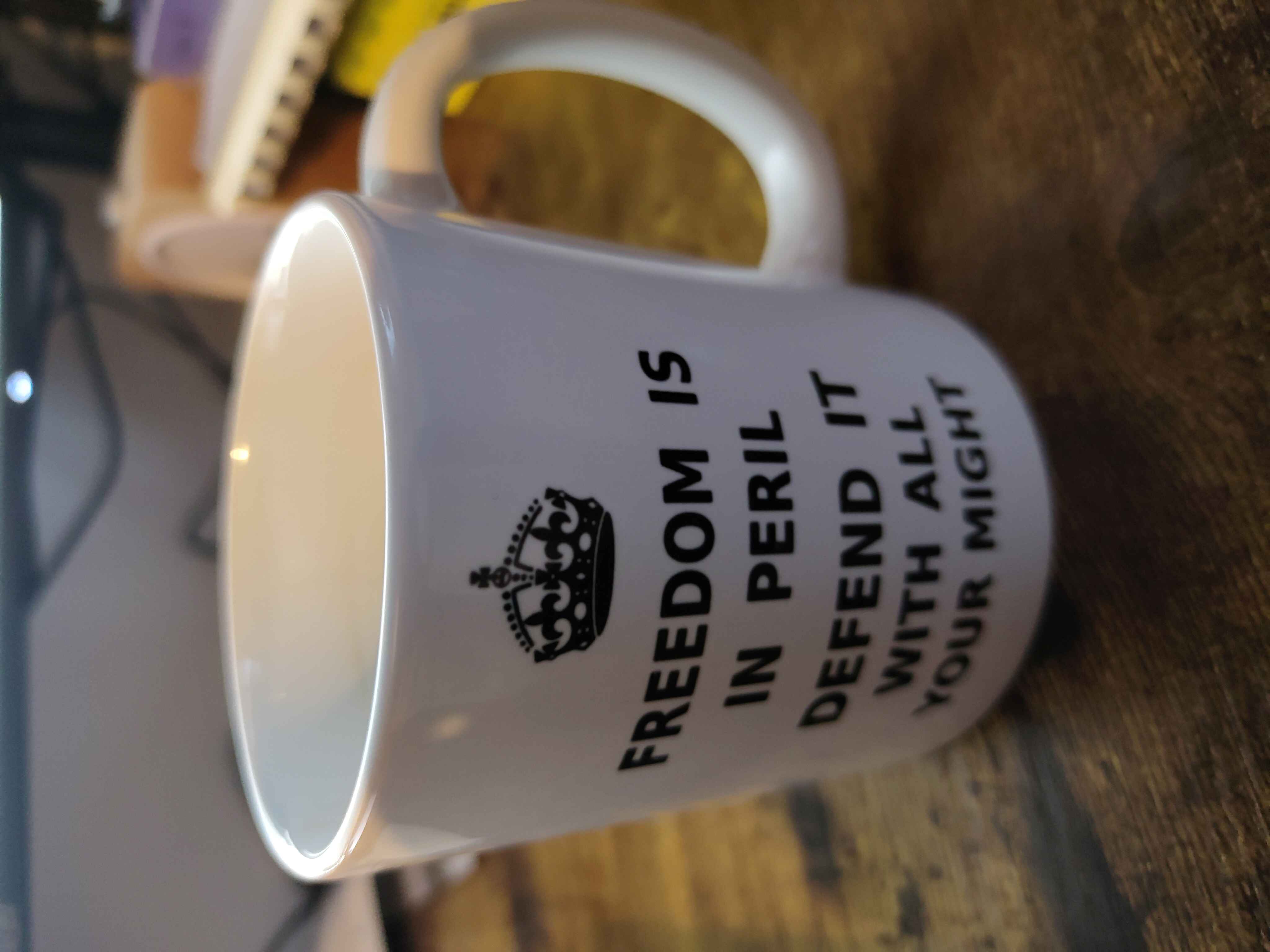
Freedom is in peril
As I wrote a few days ago, by now I consider the US—as a state—my enemy. Although it sounds like a dramatic statement, I don’t think I’m the only one who feels this way. For example, I suspect that, while very few would actually use those words, a fair proportion of Americans are coming to the same idea. But this is more about—and for—Europeans. Now, it is my clear impression that Europeans are increasingly seeing the US as an enemy or adversary, but let me try to argue that this is the case. First, I want to explain what I mean by “the US.”
Under “the US,” I do not mean individual Americans. I also don’t mean the entire US political establishment, because it is clear that had the 2024 elections gone differently, I would not be writing this. But it was Trump/MAGA who won. They are the ones who fully dominate US state power. And this is even truer when it comes to anything related to foreign relations. Trump/MAGA is shaping official US policy—the policy that US diplomats must pursue, the directives that US trade negotiators and the US military must follow, and so on. These people will be in power for at least three more years. Who knows what will happen afterward, but for now, they are “the US.”
Now that this has been clarified, what does “the US” want? It is evident that “the US” does not like the EU. And why? First, because the EU, with all its faults, is a problem for them. Think about it: when it comes to trade deals, environmental rules, food safety, privacy rights, regulation of social media, industrial policy, financial regulation—you name it—it would be much simpler to deal with European countries piecemeal rather than with the EU as a whole. In the past year, the EU has imposed fines close to 4 billion EUR on Google, Meta, Twitter, and Apple. And they will pay them, because for Google, losing its advertising business in Europe would be really painful. Now, how much of a fine could France impose? None. Let alone Portugal or the Netherlands.
Now, you might tell me that this has to do with big American businesses, not the US as a state. My friend, you would be enormously naïve. First, all states support their companies. At the end of the day, the original “banana republic” was the fictionalization of Central American countries where, at the beginning of the 20th century, the US intervened militarily all the time to defend the interests of United Fruit Company. But while states always have the interests of their companies in mind, right now it is pretty blatant. And dark. Trump/MAGA, and the official US position as represented by their National Security Strategy, place huge emphasis on the alleged lack of free speech in Europe:
The larger issues facing Europe include activities of the European Union and other transnational bodies that undermine political liberty and sovereignty, migration policies that are transforming the continent and creating strife, censorship of free speech and suppression of political opposition, cratering birthrates, and loss of national identities and self-confidence.
Now, if you truly believe that there is no freedom of speech in Europe, you either don’t understand what freedom of speech is, are crazily ideological, or have no fucking clue what happens here. What is going on is that social media companies do not want any regulation. Why don’t they? The reason Twitter/X was recently fined by the EU is for manipulating its algorithm to amplify extreme political messages, creating alarm about illegal immigration and whatever else. What is the effect of this? Well, almost 70% of Europeans overestimate the number of immigrants in Europe, with the average estimate being 16% of the population—when in reality, it is 7%, and overwhelmingly legal. Indeed, in the first nine months of 2025, 135,000 illegal immigrants entered the EU. That is 0.03% of the European population. And, other than a spike in 2015, this number has been pretty stable. Since 2014, including the spike, there has been an average of 260,000 illegal immigrants coming into Europe per year: 0.06% of the population. Still, fears of illegal immigration decide elections. And those fears are artificially amplified by social media companies, partly for political reasons and partly because it is profitable to create drama. And it is official US policy to do everything possible to prevent European states from doing anything about it.
Now, one can think whatever one wants about climate change (honestly, that is just a way of speaking), but it is evident that for resource-poor European countries, it makes total sense to electrify as much as possible, relying as much as possible on renewables. Climate change is only mentioned once in the US’s National Security Strategy, in the following paragraph:
Energy Dominance – Restoring American energy dominance (in oil, gas, coal, and nuclear) and reshoring the necessary key energy components is a top strategic priority. Cheap and abundant energy will produce well-paying jobs in the United States, reduce costs for American consumers and businesses, fuel reindustrialization, and help maintain our advantage in cutting-edge technologies such as AI. Expanding our net energy exports will also deepen relationships with allies while curtailing the influence of adversaries, protect our ability to defend our shores, and—when and where necessary—enables us to project power. We reject the disastrous “climate change” and “Net Zero” ideologies that have so greatly harmed Europe, threaten the United States, and subsidize our adversaries.
It is clear that the US has a vested interest in selling natural gas to Europe—that is, in locking European countries into long-term natural gas contracts. During tariff discussions, there was a huge emphasis on Europe buying prodigious amounts of natural gas from the US. Again, it would be much easier to bully individual countries into doing that than dealing with the EU as a whole.
Another explicit goal in the National Security Strategy paper:
Preserving and Growing America’s Financial Sector Dominance – The United States boasts the world’s leading financial and capital markets, which are pillars of American influence that afford policymakers significant leverage and tools to advance America’s national security priorities. But our leadership position cannot be taken for granted. Preserving and growing our dominance entails leveraging our dynamic free market system and our leadership in digital finance and innovation to ensure that our markets continue to be the most dynamic, liquid, and secure and remain the envy of the world.
This is again much easier if the EU does not exist. Right now, there is no European capital market worth mentioning, but it seems to be one of those things that is inching toward becoming a reality. There are no Eurobonds, and since it is relatively small, the debt of individual European countries is simply much less liquid than that of the US. But this is also something that could very well happen. Neither a European capital market nor Eurobonds would be in the US’s interest.
The list of examples could go on, but it is clear that the US has plenty of reasons to wish the EU ill. I repeat: because it would be much simpler to deal with European countries piecemeal.
Now, all those economic factors were there before the 2024 elections, and surely a Kamala Harris administration would have kept the economic interests of tech companies, energy producers, and financial companies in mind. But a Kamala Harris administration would not have decided that directly intervening in European politics is an explicit goal of official US policy. In fact, intervening in favor of extreme right-wing, anti-European parties:
We will oppose elite-driven, anti-democratic restrictions on core liberties in Europe, the Anglosphere, and the rest of the democratic world, especially among our allies.
American diplomacy should continue to stand up for genuine democracy, freedom of expression, and unapologetic celebrations of European nations’ individual character and history. America encourages its political allies in Europe to promote this revival of spirit, and the growing influence of patriotic European parties indeed gives cause for great optimism.
The language that official US policy uses to speak about Europe is also clearly racist. If this is not already clear when it speaks of the real and stark prospect of civilizational erasure of Europe, or about restoring Europe’s civilizational self-confidence and Western identity, it becomes undeniable when it writes:
Over the long term, it is more than plausible that within a few decades at the latest, certain NATO members will become majority non-European. As such, it is an open question whether they will view their place in the world, or their alliance with the United States, in the same way as those who signed the NATO charter.
It is official US policy, not a speech, not an extemporaneous declaration, to work toward a white Europe dominated by patriotic parties that oppose the European Union and other transnational bodies that undermine political liberty and sovereignty, migration policies that are transforming the continent and creating strife, censorship of free speech and suppression of political opposition, cratering birthrates, and loss of national identities and self-confidence.
Why all of this? It is surely ideological, and there are the economic interests I mentioned above. But I also suspect that for Trump/MAGA, it would be much less annoying to have to deal with wannabe autocrats like themselves. A bit like Putin. If decency, respect for the law, and democratic norms are not respected anywhere, it must be much easier to not respect them at home. But the “why?” is more a question for Americans than for me. To me, what is evident is that the US is going to use its power to make my life much worse, my society much worse, to make me and people living here even more powerless. I repeat: the US is the enemy.